

Latin America is not one market, and treating it as one is the most expensive mistake in Spanish and Portuguese SEO. Mexico, Colombia, Argentina, Chile, Peru and Brazil each have their own vocabulary, their own publishers, their own price expectations and their own search results. Brazil, the biggest of them, does not speak Spanish at all. Latin American link building has to be planned country by country.
Get the segmentation right and the upside is huge. Hundreds of millions of searchers, e-commerce growing fast, and keyword competition that in most verticals is still nowhere near the equivalent English terms.
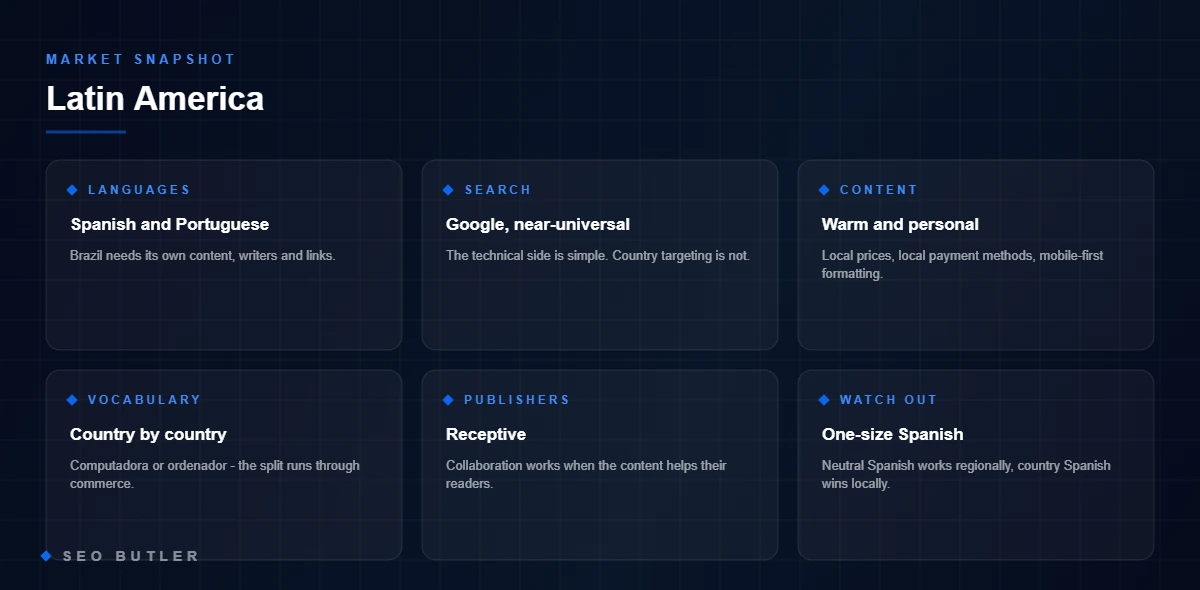
The Latin American search landscape
Google is close to universal across the region, which makes the technical side easy and the targeting hard. Neutral Latin American Spanish works for a regional brand. Country-specific Spanish wins when you are competing locally, because the words people type are different. A computer is a computadora in Mexico and an ordenador in Spain, and that kind of split runs through most commercial vocabulary.
Brazilian Portuguese needs its own content, its own writers and its own links. Portuguese from Portugal reads as foreign to a Brazilian audience, and Google treats the two as separate languages.
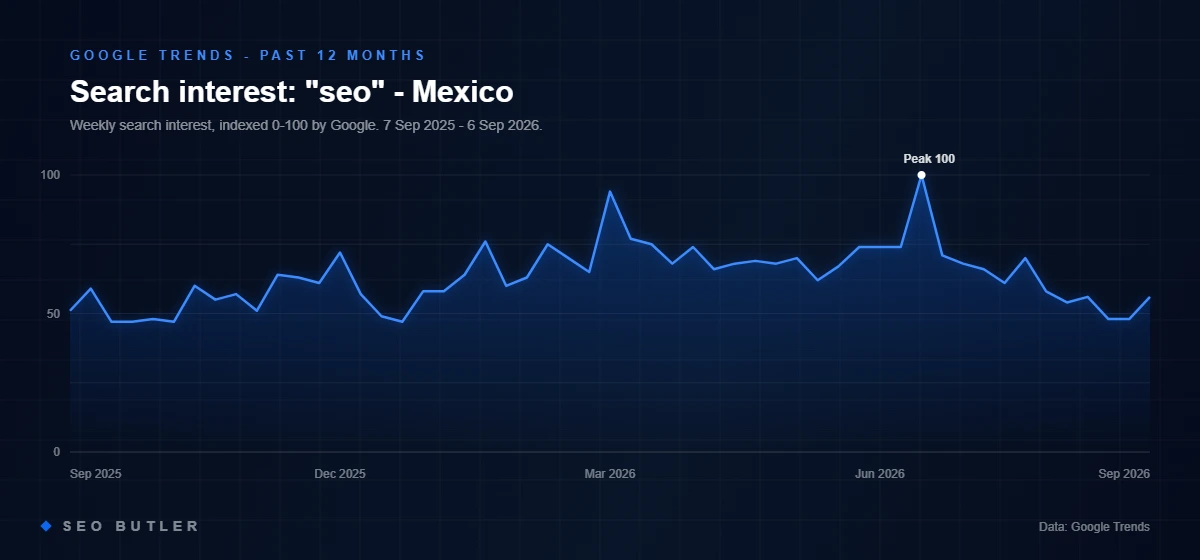
LATAM Spanish router: one language, twenty markets, different keywords
Spanish unites Latin America; vocabulary divides it. The same product is searched with different words in Mexico City and Buenos Aires, and a “neutral Spanish” page leaves volume on the table everywhere. Pick a market to see what changes.
| Concept | Local term to target | Notes |
|---|---|---|
| Mobile phone | celular | “móvil” reads as Spain-Spanish; hreflang es-MX, prices in MXN |
| Computer | computadora | Peninsular “ordenador” kills relevance in Mexico |
| Rent / lease | rentar · renta | Elsewhere “alquilar” — the verb IS the keyword split |
| Money (colloq.) | plata · guita | Finance queries mix formal and lunfardo forms; hreflang es-AR, ARS pricing with inflation context |
| You (informal) | vos + voseo verbs | “tenés”, “podés” — tú-form copy reads foreign in Argentina |
| Car | auto | “coche” is Spain, “carro” is the Andes and Caribbean |
| Car | carro | hreflang es-CO; COP pricing, local payment rails (PSE) in commercial copy |
| Cool / great | chévere · bacano | Tone markers that make review content read local |
| Apartment | departamento · depto | hreflang es-CL; the abbreviation carries real volume |
| Money (colloq.) | plata · lucas | “lucas” = thousands of pesos — price-point queries use it |
The structural fix: es-419 as a fallback page plus per-country pages for your top two or three markets, tied together with correct hreflang — generate the cluster with the hreflang generator.
Our LATAM list is early-stage and curated — the wider marketplace backs campaigns while it grows.
What ranks in Spanish and Portuguese
Warm, personal writing that reads like a relationship, with local prices, local payment methods and local examples. Latin American publishers are usually open to working together when the approach is human and the content is useful to their readers. Mobile-first formatting is not optional either, because for a large part of the region the phone is the only device.
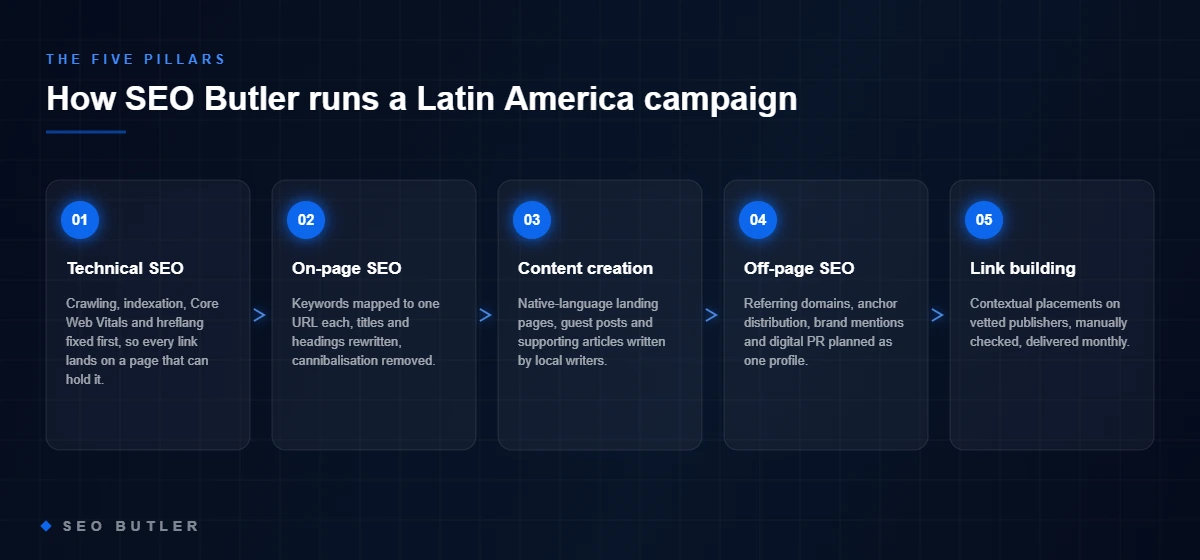
How SEO Butler builds authority in Latin America
SEO Butler is a backlink marketplace and content studio in Malta, and Latin America is one of the nine markets we cover. We run Spanish and Portuguese sites of our own as well, and the way we build their authority is the same five-part routine we use everywhere. It is worth setting out, because it is also the standard every Latin American site in the marketplace is held to.
Technical SEO
Technical SEO goes first on our own sites, because links pointed at a site that cannot hold them are wasted. Crawlability, indexing, Core Web Vitals, hreflang and the internal link structure all get checked. With several Spanish variants and Brazilian Portuguese sitting on one site, hreflang and canonicals are where most of the trouble is.
On-page SEO
On-page SEO gives each Spanish and Portuguese page one clear job: the right local term on the right URL, no country versions competing with each other, and titles, headings and internal anchors written for the country rather than adapted from English. If you are buying links in the region, have this in order first.
Content creation
Content creation is the part of this we sell. Native Spanish and Portuguese writers, each working in their own variant of the language, produce landing pages, guides and supporting articles for clients’ own sites, and the articles that carry a placement. None of it reads like a translation.
Off-page SEO
Latin American rankings are decided as much by what points at a page as by what is on it. Off-page SEO on our own sites means watching referring domains, anchor text spread, brand mentions and the local citations each country’s results reward, and buying placements at a steady pace rather than in bursts.
Link building
Link building for our Latin American sites goes through the same marketplace you can buy from: editorial links on real Spanish and Portuguese sites with real readers, every placement checked by a person, on established sites rather than link farms, and anchor text planned across the whole campaign rather than one link at a time.
Search engine optimisation as one campaign
None of the five works on its own. The search engine optimisation page describes how we run them together on our own sites, so the Spanish and Portuguese content is technically sound, correctly targeted and supported by links from the day it goes live.
Where Spanish and Portuguese backlinks come from
Latin American placements are bought through the SEO Butler backlink marketplace, where every site is listed with its traffic and metrics. You look through the Latin America sites, pick the ones that fit your pages and your countries, and order. Every one of them is held to real editorial standards, not picked on a number.
If you want a view on which sites suit your pages, or Spanish or Portuguese articles to go with the placements, ask. The six SEO services pages explain how we approach each area on our own sites.
Frequently asked questions about Spanish and Portuguese link building
Do you use native Spanish and Portuguese writers?
Yes, for everything: the articles and the guest posts, each in the right variant for the country. Machine-translated content does not go on our sites, and it reads badly to the people you want to convert.
How many Spanish and Portuguese links do I need?
Look at the referring domains of the current top ten for your keywords in each country and compare them with yours. That gap, spread over a few months at a natural pace, is your volume. Send us the keywords and we will tell you what we would do for one of our own sites.
Can I buy Spanish and Portuguese links without the rest of the SEO?
Yes, and that is how the marketplace works. You buy the placements and look after your own site; if you want native Spanish or Portuguese content for your pages or for the placements, we write that too. Link building on its own is what most customers come for.
Which other markets do you cover?
Denmark, Sweden, Finland, Norway, Japan, South Korea, Thailand and Latin America, plus an international list for markets outside those. Campaigns across several markets are common, and they share one strategy and one anchor plan.
Start building Spanish and Portuguese links
Browse the backlink marketplace to see the Latin America inventory, or get in touch with SEO Butler if you would like a view on which publishers suit your pages and countries, or need Spanish or Portuguese content to go with them.