

South Korea is about as digitally advanced as a market gets, and about as unforgiving of foreign SEO teams. Korean readers are used to fast, dense, heavily illustrated pages, and Korean search does not revolve around Google the way most markets do. Content and links that work everywhere else can simply fail to register here, which is why Korean link building is its own discipline.
The language is its own filter. Korean is written in Hangul, it shifts register with the audience through its honorific forms, and it carries a large stock of borrowed English words that are spelled and used in distinctly Korean ways. Translated copy gives itself away within a sentence, and Korean readers leave.
The Korean search landscape
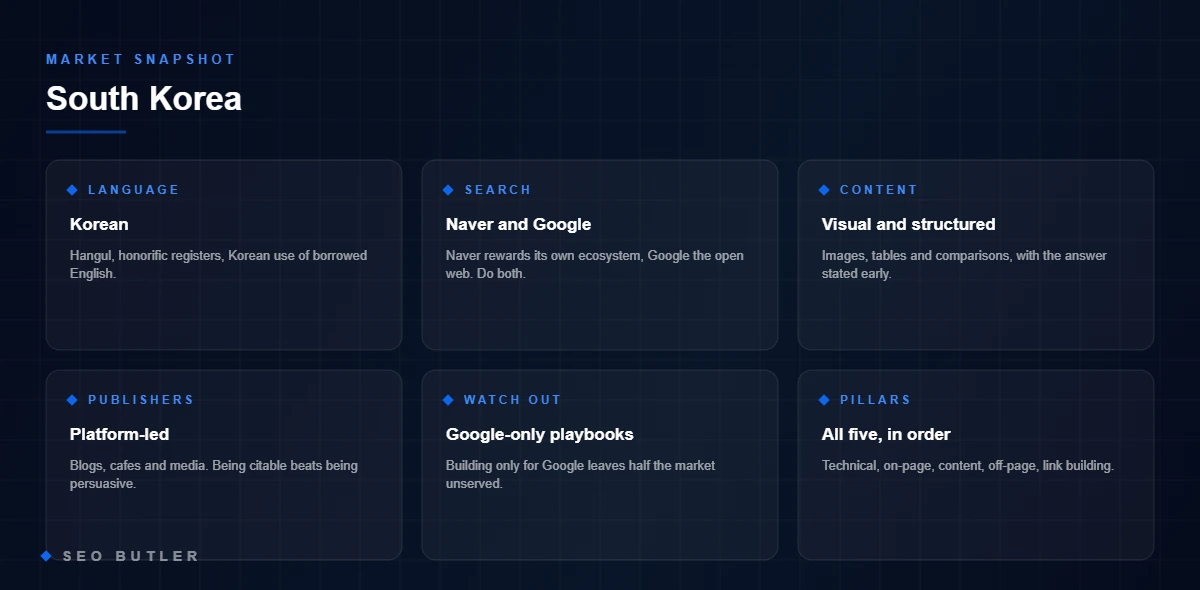
Naver still takes a large share of Korean search. Google has the rest and is growing, with Daum and Kakao in the mix. The two behave differently: Naver favours content published inside its own ecosystem, blogs, cafes and Knowledge iN, while Google rewards the open web the way it does everywhere else. A serious Korean campaign works both sides, with standard on-page work and link building for Google and a presence on the platforms Naver surfaces.
That split is the main reason Korean campaigns run from an English playbook fall flat. Build only for Google and half the market never sees you. Build only for Naver and you are invisible to the half that is growing fastest.
What ranks in Korean
Pages that are visual, well structured and generous with evidence, with the answer stated early. Korean readers expect images, tables and comparison blocks, and they trust content that shows its working. Korean publishers, for their part, link to references that make their own article stronger, so whatever you build has to be worth citing.
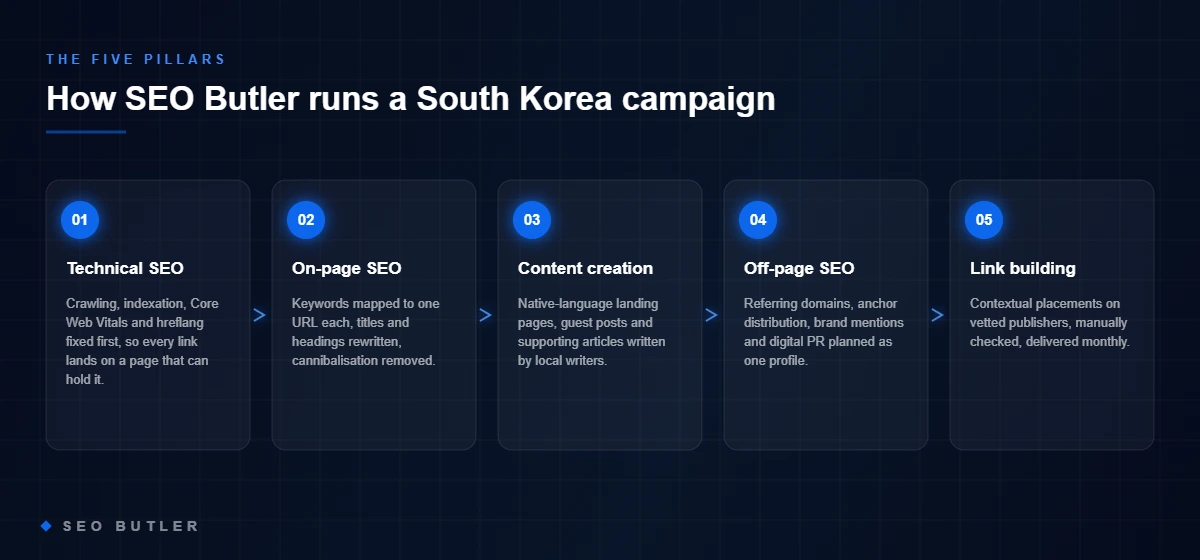
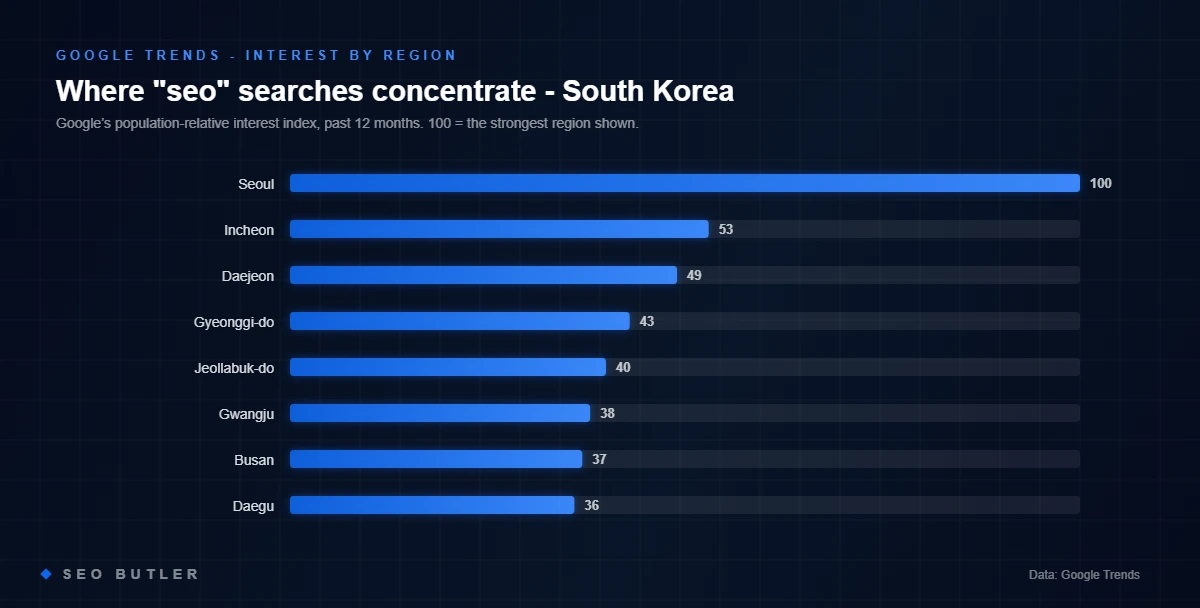
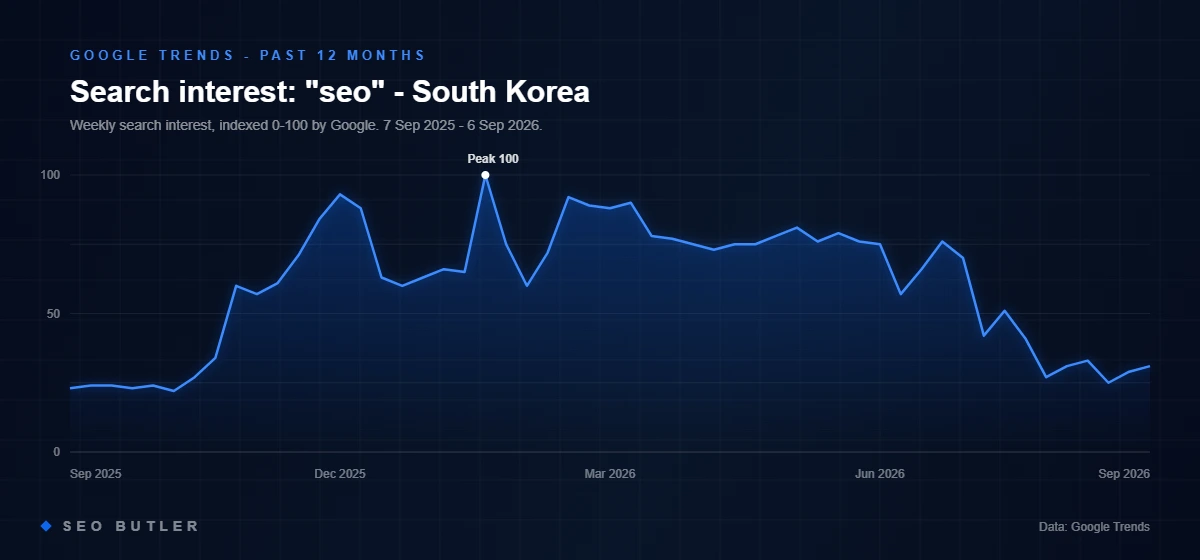
How SEO Butler builds authority in South Korea
SEO Butler is a backlink marketplace and content studio in Malta, and South Korea is one of the nine markets we cover. We run Korean sites of our own too, and the way we build their authority is the same five-part routine we use everywhere. It is worth setting out, because it is also the standard every Korean site in the marketplace is held to.
Technical SEO
Technical SEO comes first on our own sites, since links pointed at a site that cannot hold them are wasted. Crawlability, indexing, Core Web Vitals, hreflang and the internal link structure all get checked, and when a Korean version sits beside other language versions of the same site, hreflang and canonicals need particular attention.
On-page SEO
On-page SEO gives each Korean page one clear job: the right keyword on the right URL, no near-duplicate pages fighting each other, and titles, headings and internal anchors written in Korean rather than adapted from English. If you are buying Korean links, have this in order first.
Content creation
Content creation is the part of this we sell. Native Korean writers produce landing pages, guides and supporting articles for clients’ own sites, and the articles that carry a placement, in the register the audience expects, so nothing reads like a translation.
Off-page SEO
Korean rankings are decided as much by what points at a page as by what is on it. Off-page SEO on our own sites means watching referring domains, anchor text spread, brand mentions and the local citations Korean results reward, and buying placements at a steady pace rather than in bursts.
Link building
Link building for our Korean sites goes through the same marketplace you can buy from: editorial links on real Korean sites with real readers, every placement checked by a person, on established sites rather than link farms, and anchor text planned across the campaign rather than one link at a time.
Search engine optimisation as one campaign
None of the five works on its own. The search engine optimisation page describes how we run them together on our own sites, so the Korean content is technically sound, correctly targeted and supported by links from the day it goes live.
Where Korean backlinks come from
Korean placements are bought through the SEO Butler backlink marketplace, where every site is listed with its traffic and metrics. You look through the South Korea sites, pick the ones that fit your pages, and order. Every one of them is held to real editorial standards, not picked on a number.
If you want a view on which sites suit your pages, or Korean articles to go with the placements, ask. The six SEO services pages explain how we approach each area on our own sites.
Frequently asked questions about Korean link building
Do you use native Korean writers?
Yes, for everything: the articles and the guest posts. Machine-translated content does not go on our Korean sites, and it reads badly to the people you want to convert.
How many Korean links do I need?
Look at the referring domains of the current top ten for your Korean keywords and compare them with yours. That gap, spread over a few months at a natural pace, is your volume. Send us the keywords and we will tell you what we would do for one of our own sites.
Can I buy Korean links without the rest of the SEO?
Yes, and that is how the marketplace works. You buy the placements and look after your own site; if you want native Korean content for your pages or for the placements, we write that too. Link building on its own is what most customers come for.
Which other markets do you cover?
Denmark, Sweden, Finland, Norway, Japan, South Korea, Thailand and Latin America, plus an international list for markets outside those. Campaigns across several markets are common, and they share one strategy and one anchor plan.
Start building Korean links
Browse the backlink marketplace to see the South Korea inventory, or get in touch with SEO Butler if you would like a view on which publishers suit your pages or need Korean content to go with them.