


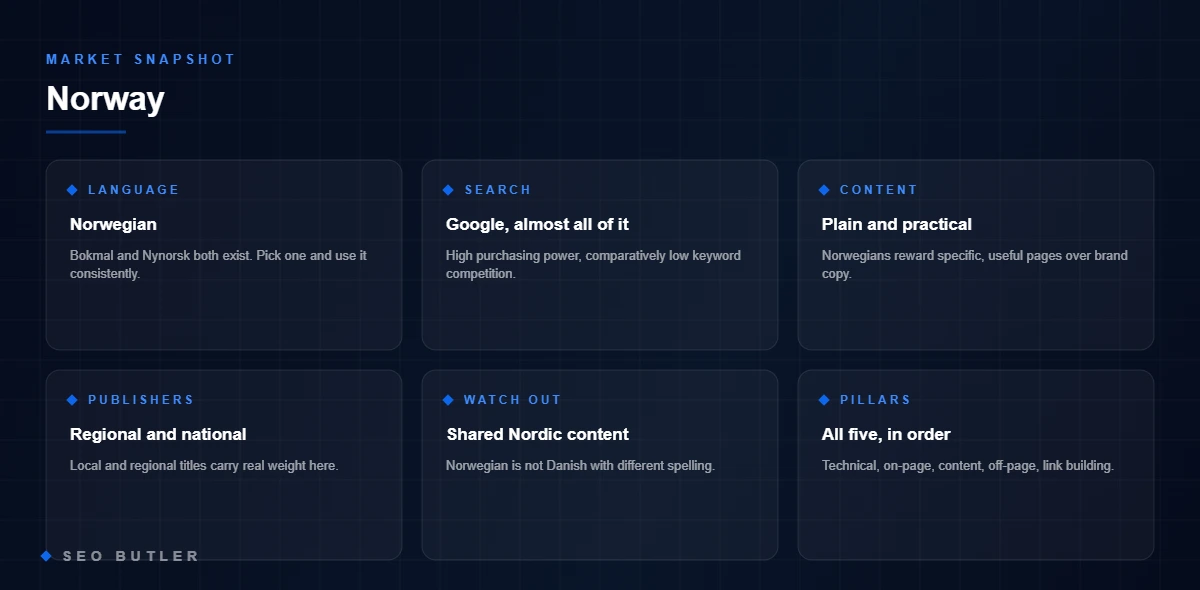
Norway has about 5.4 million people, nearly all of them online, most of them comfortable spending money on the internet, and almost all of them searching in Norwegian. It is a small market with a lot of purchasing power and not much competition for Norwegian-language keywords, which is exactly the kind of market that rewards doing the content, and the Norwegian link building behind it, properly.
At SEO Butler we write Norwegian content for companies that want to rank and sell in Norway, from the keyword research to the finished article, with Norwegian writers rather than translation. We also run Norwegian sites of our own, which is where most of what follows was learned.
Here is how that works.
Understanding the Norwegian market
Norwegians are direct, well informed and quick to spot a company that is only pretending to be local. They respond to content that is plainly written, accurate and clearly made for them.
That means Norwegian content has to reflect how people in Norway actually live and talk, not a tourist-brochure version of it, and it has to be in the written form and register they expect.
Bokmål or Nynorsk: which Norwegian should your site target?
Norway has two official written languages, and Google treats them as related but distinct query spaces. Most sites should not split their effort — answer three questions to see where yours lands.
Who are you selling to?
Does your sector involve public institutions (education, municipal services, agriculture)?
Which region?
Write everything in Bokmål
Roughly nine in ten Norwegians write Bokmål, and commercial search volume follows it. Duplicating pages into Nynorsk splits internal links and crawl budget for volume that is not there. Spend the saved budget on Norwegian links instead.
Bokmål site, Nynorsk for institutional pages
Public-sector audiences include committed Nynorsk users, and some tenders expect it. Keep the site Bokmål, add Nynorsk versions of the pages those audiences actually read, and hreflang both as no variants rather than separate countries.
Bokmål core, Nynorsk trust touches
Vestlandet is the Nynorsk heartland. Rank with Bokmål — the volume is still there — but local Nynorsk touches on landing pages and in review responses lift conversion, which is the metric that pays.
Rounded averages from our Norwegian publisher list; the premium is an educational sample, not live pricing.
The importance of Norwegian content for your website
Norwegians speak good English, but they search, read and buy in Norwegian. A page in the local language is clearer, feels more trustworthy and converts better, and it is the only kind of page Google.no will rank for Norwegian searches. If Norway is a market you care about, English-only content is leaving most of it on the table.
There is a cultural layer as well. Norwegians value authenticity, nature and a sense of place, and content that draws on local seasons, traditions and current issues lands better than generic copy. Mentioning the things Norwegians actually organise their year around, the ski season, the summer holidays, the seventeenth of May, does more for engagement than any amount of polish.
How we can assist with your Norwegian content
We produce Norwegian content built for your business and your market, and we cover every stage of it: research, writing, on-page details and editing. What you get is copy ready to publish.
Keyword research and content planning
Everything starts with what Norwegians search for. We use the keyword tools to find the terms with real volume in your industry, and we go beyond the tools to account for regional wording and the two written forms of the language, so the content plan is built on what people in Norway actually type.
Search intent matters as much as volume. A popular term is only useful if the people searching it want what you sell, so we look at what each query really means before it goes on the plan.
Content creation
Our writers are native Norwegians. They write blog posts, articles, guides and product copy that reflect Norwegian culture and interests, and they write to be read, not just to carry keywords.
Each piece is researched properly, whether that means current events in Norway, local customs or the technical detail of your product, so the content holds up with readers who know the subject.
Norwegian is not one written language. There are two official forms, Bokmål and Nynorsk, and while Bokmål dominates online, Nynorsk matters in parts of the west and in certain public and educational contexts. Spoken Norwegian varies a great deal too, from Oslo to Bergen to Tromsø, and the dialects colour how people write informally. Choosing the wrong form for the audience is an easy way to look foreign.
Our writers know which form and which register fit the audience you are targeting, and they adjust the phrasing to match, so the content feels local to the people reading it rather than local in general.
Visuals count as well. Where a piece benefits from images or infographics, our writers work with designers to add them, so the page is easier to read and easier to share.
SEO optimisation
Good content that nobody finds is wasted, so the on-page work is part of the writing. Each Norwegian page arrives with its title, meta description, headings, keyword placement and internal links done.
The site around it, speed, mobile layout and the technical basics that decide whether Google trusts it, is yours to look after. On our own sites we treat that as the first job, before any content goes up.
The aim is straightforward. When a Norwegian searches for what you sell, your page is one of the ones they see.
Editing and proofreading
Every piece is edited and proofread by a Norwegian editor before it goes anywhere. They check grammar, flow and readability, and they check that the message comes across the way it was meant to, with the cultural references right and the tone appropriate.
Norwegian content should read cleanly, without the small errors and odd phrasings that mark a page as translated. Our editors fix those while keeping the writer’s voice intact.
Publishing and promoting
When the content is approved it is yours to publish. If the piece is meant for a Norwegian site other than your own, that is what the marketplace is for: the same writers produce the placement articles, and we know which Norwegian publishers are worth being seen on.
Promotion is your call. The pieces that do best in Norway tend to be the ones shared on Facebook and Instagram by people who found them useful, which is a good argument for writing them properly in the first place.
Where the links come from
Norwegian backlinks are what move Norwegian rankings. Our marketplace lists real Norwegian websites with real readers, over a hundred and fifty of them, one of the deepest lists we have, each listed with its traffic and metrics.
Links in a market this small depend on the sites being real. The ones in the marketplace are: Norwegian sites with real readers, run by people who know the market, which means your placement reaches those readers as well as earning the link.
We would rather place ten links that last than a hundred that vanish, and a Norwegian link profile built that way keeps working year after year. It is how we build our own.
Creating engaging Norwegian content
The content that does best in Norway is the content that knows Norway. National pride runs deep, and pieces that draw on Norwegian figures, from Munch to Nansen, or on the country’s history and landscape, tend to get read and shared.
Seasons matter as well. Winter means skiing and everything around it; summer means festivals, cabins and the outdoors. Content timed to those rhythms gets attention when Norwegians are already thinking about the subject, and we plan the calendar with that in mind.
Stories carry all of this better than lists of facts. A piece built around a real event, a local issue or a question Norwegians are debating, sustainability and cultural preservation come up a lot, gives your brand a place in the conversation rather than a slot in the results.
Then there is the language itself. Between the two written forms and the strong regional dialects, from Bergen’s distinctive sound to the expressions of the far north, there is a lot of room to get the register wrong. Our writers match it to the audience: informal for a younger crowd, more formal for a corporate one, and always in the form of Norwegian that audience reads.
Finally, Norwegians care how things are made and sold. Sustainability and ethical consumption are real purchase factors, not marketing slogans, so content that is honest about environmental practice or supports local producers speaks to the way a lot of Norwegians decide what to buy.
FAQs
Why is content important for SEO in Norway?
Because Google ranks pages that match the language and intent of the search. Content written in native Norwegian is more relevant to Norwegian searches, earns more clicks from the results, and ranks higher than translated or English-only pages.
What should I focus on when creating SEO content?
Accuracy, clarity and usefulness. Norwegians expect well-researched content with proper sources and precise information, written the way Norwegians write. Get the cultural details right and answer the question properly.
How can I optimise Norwegian content for better search rankings?
Use natural Norwegian keywords, write clearly with authority, link between your related pages, and structure the page with proper headings. Then make sure it loads quickly and works on a phone, because both of those affect how well it ranks in Norway.
Tell us what you’re targeting and we’ll come back with a plan, or browse the backlink marketplace to see what’s available in Norway.
How SEO Butler builds authority in Norway
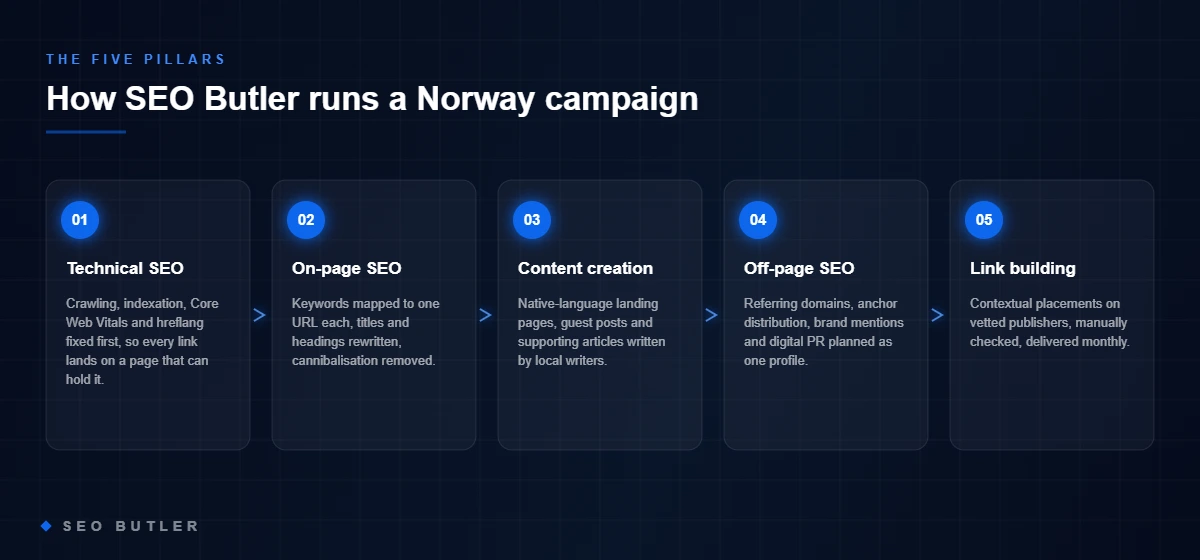
SEO Butler is a backlink marketplace and content studio in Malta, and Norway is one of the nine markets we cover. We run Norwegian sites of our own too, and the way we build their authority is the same five-part routine we use everywhere. It is worth setting out, because it is also the standard every Norwegian site in the marketplace is held to.
Technical SEO
Technical SEO goes first on our own sites, because a site that cannot hold the value of a link wastes it. Crawlability, indexing, Core Web Vitals, hreflang and the internal link structure all get checked, and hreflang and canonicals need particular care when a Norwegian version sits alongside other language versions of the same site.
On-page SEO
On-page SEO gives every Norwegian page one job: the right keyword on the right URL, no near-duplicate pages fighting each other, and titles, headings and internal anchors written for Norway rather than adapted from English. If you are buying Norwegian links, have this in order first.
Content creation
Content creation is the part of this we sell. Native writers produce landing pages, guides and supporting articles for clients’ own sites, and the articles that carry a placement, so nothing reads like a translation.
Off-page SEO
In Norway the rankings are decided as much by what points at a page as by what is on it. Off-page SEO on our own sites means watching referring domains, anchor text spread, brand mentions and the local citations Norwegian results reward, and buying placements at a steady pace rather than in bursts.
Link building
Link building for our Norwegian sites goes through the same marketplace you can buy from: editorial links on real Norwegian sites with real traffic, each placement checked by a person, no PBNs, link farms or automated outreach, and anchor text planned across the whole campaign rather than one link at a time.
Search engine optimisation as one campaign
None of the five works on its own. The search engine optimisation page describes how we run them together on our own sites, so the Norwegian content is technically sound, correctly targeted and supported by links from the day it goes live.
Where Norwegian backlinks come from
Norwegian placements are bought through the SEO Butler backlink marketplace, where every site is listed with its traffic and metrics. You look through the Norway sites, pick the ones that fit your pages, and order. Every one of them is held to real editorial standards, not picked on a number.
If you want a view on which sites suit your pages, or Norwegian articles to go with the placements, ask. The six SEO services pages explain how we approach each area on our own sites.
Frequently asked questions about Norwegian link building
Do you use native Norwegian writers?
Yes, for everything: the articles and the guest posts. Machine-translated content does not go on our Norwegian sites, and it reads badly to the people you want to convert.
How many Norwegian links do I need?
Look at the referring domains of the current top ten for your Norwegian keywords and compare them with yours. That gap, spread over a few months at a natural pace, is your volume. Send us the keywords and we will tell you what we would do for one of our own sites.
Can I buy Norwegian links without the rest of the SEO?
Yes, and that is how the marketplace works. You buy the placements and look after your own site; if you want native Norwegian content for your pages or for the placements, we write that too. Link building on its own is what most customers come for.
Which other markets do you cover?
Denmark, Sweden, Finland, Norway, Japan, South Korea, Thailand and Latin America, plus an international list for markets outside those. Campaigns across several markets are common, and they share one strategy and one anchor plan.

Start building Norwegian links
Browse the backlink marketplace to see the Norway inventory, or get in touch with SEO Butler if you would like a view on which publishers suit your pages or need Norwegian content to go with them.