


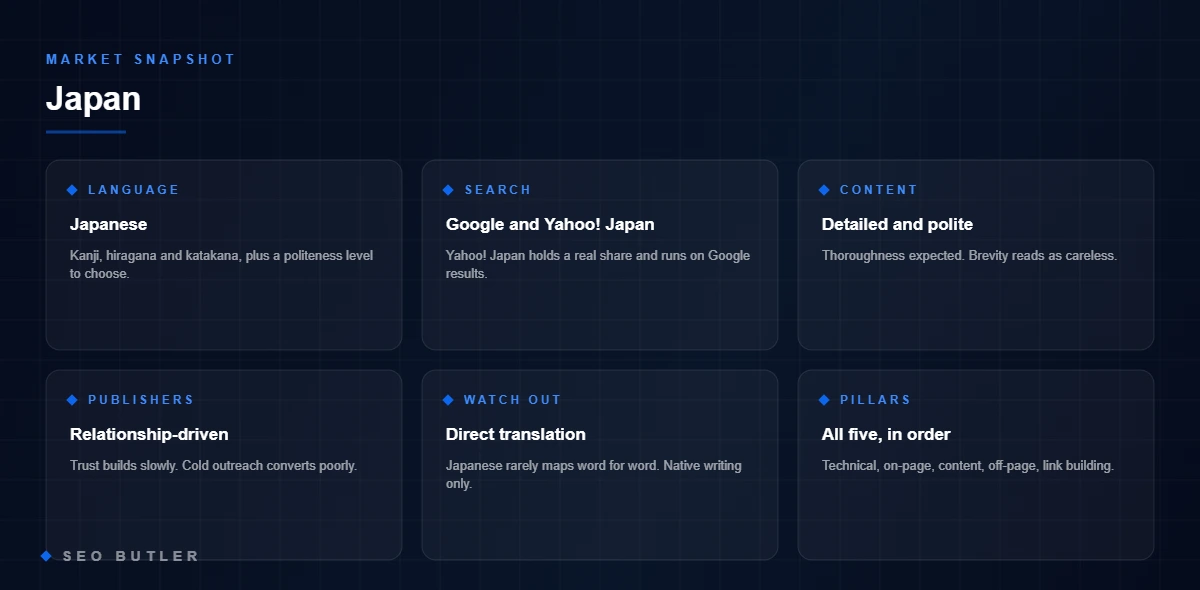
Japan is one of the biggest online markets in the world and one of the least forgiving. Nearly everyone is connected, e-commerce is enormous, and Japanese consumers read carefully before they buy. They also read in Japanese, and they notice immediately when a page was not written by someone who does. If Japan is on your list, Japanese content is not a nice-to-have, and neither is Japanese link building.
The language is the first hurdle. Japanese uses three scripts at once: kanji, the characters borrowed from Chinese that carry most of the meaning; hiragana, the phonetic script for native words and grammar; and katakana, used mainly for foreign words and loanwords, which includes a lot of product and brand vocabulary. A normal sentence mixes all three, and the choice between them is not free. Write a word in the wrong script and it looks odd; write it in the right one and it looks like a Japanese company wrote it. On top of that sit the levels of politeness. Japanese has formal and informal registers with their own verb forms, and marketing copy usually has to move between them depending on the audience and the platform. Getting that right is a large part of whether Japanese readers take a brand seriously.
Why do content marketing in Japan?
Because the audience is there. Japan has one of the most engaged online populations anywhere, and Japanese people read a great deal of content before they make a decision, which suits content marketing well.
Japanese consumers are loyal once won and demanding before that. They pay attention to detail, they expect things to be done properly, and they reward brands that clearly understand them with a level of loyalty you rarely see elsewhere. Content that is well made and clearly Japanese earns awareness first, then trust, then sales.
The e-commerce market is also one of the largest in the world, and Japanese shoppers research online before they buy, often at length.
Give them accurate, useful information at that stage and you become the brand they trust when the time comes to order.
Japanese title checker: full-width characters change the rules
Japanese characters are roughly double the pixel width of Latin ones, so the “60 characters” rule collapses to about 28–32. Paste a title to see its real width, its script mix, and whether Google will cut it on google.co.jp.
Checking…
- Kanji 10
- Hiragana 8
- Katakana 3
- Latin/other 6
- 1Kanji carries densityMore meaning per pixel — but a kanji-only title reads formal and stiff. The blend is the craft.
- 2Katakana signals modernityLoanwords and brand terms; often what users actually type for tech and products.
- 3Brackets are convention【 】blocks are how Japanese titles flag the hook — they cost width but earn the click.
Rounded averages across our Japanese publisher list, shown for context and education.
How can we help with your Japanese content?
We write Japanese content that meets the standard Japanese readers expect. Our writers are native speakers who understand the scripts, the registers and the culture, and they write for your market rather than translating into it.
With that in place you can say what your brand needs to say in Japan, build a presence that Japanese search engines rank, and reach your marketing goals in a market that punishes shortcuts.
How Japanese content boosts your website’s SEO
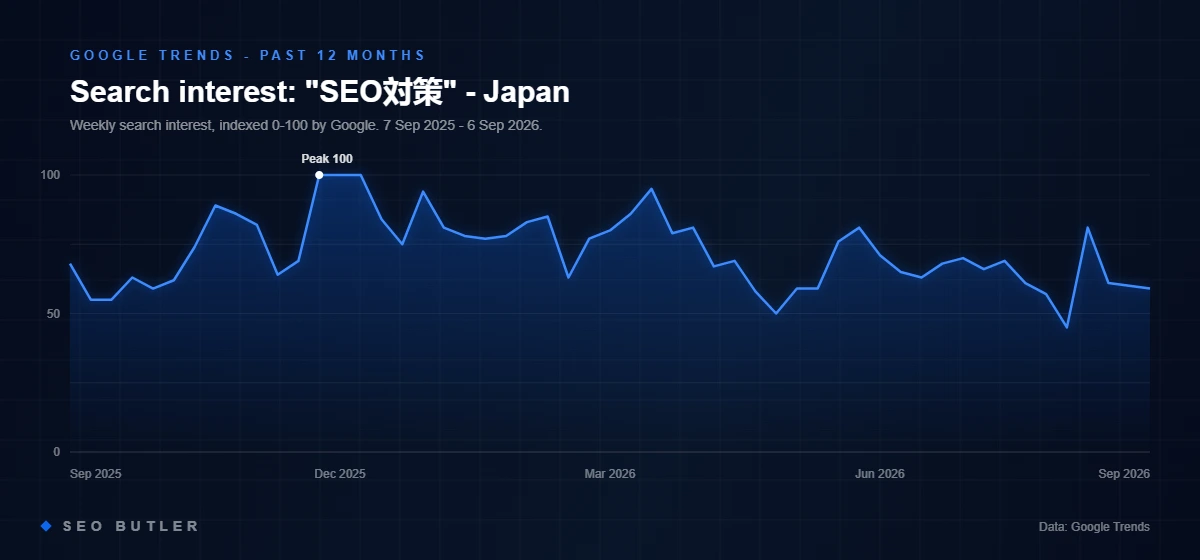
Japanese content opens up the Japanese search market, which is a large one, and it does the ordinary SEO things well: it makes the site more relevant for Japanese queries, it earns better rankings, and it keeps visitors on the page longer, because they are reading something written for them.
Both of the search engines that matter in Japan, Google Japan and Yahoo! Japan, rank pages on relevance, structure and how well they serve the reader. Content that meets that bar gets found, and it gets found by people ready to buy.
Localised pages also earn more clicks from the results, because a Japanese title in a Japanese results page is simply the one people choose.
Our Japanese content strategy
Here is how we run a Japanese content project, from the first keyword to the day it is published.
Keyword research and content planning
We start with what Japanese searchers actually type, which is not what a translation of your English keywords would suggest. The same product can be searched in kanji, in katakana and in romaji, with different volumes and different intent behind each, so we map the real terms, their competition and what the searcher wants, and build the content plan from that: topics, formats and a publishing schedule that fits your goals.
Content creation
Then the writing. Articles, blog posts, landing pages, social updates, whatever the plan calls for, each one written by a native Japanese writer in your brand’s voice and aimed at what your Japanese readers need.
Japanese readers respond to context and story more than to hard sell. We draw on local customs, seasons and values where they fit, so the content reads as something made for Japan rather than something adapted to it, and the brand feels closer for it.
SEO optimisation
The writing is only useful if it ranks, so each page arrives with the on-page work done: a title tag and meta description in natural Japanese, headings, internal links, and the keywords placed where they count without stuffing. The aim is visibility on Google Japan and Yahoo! Japan for the terms that bring in customers.
The site around the page is yours to look after. Speed, mobile layout and HTTPS all affect both the reader’s experience and the ranking, and Japanese users, most of them on phones, have little patience for slow pages. On our own Japanese sites that is the first thing we fix.
Editing and proofreading
Every piece is edited and proofread by a Japanese editor before you see it. Accuracy, flow, script choice, politeness level and cultural fit are all checked, because Japanese readers hold content to a high standard and a small mistake can undo a lot of good work.
Publishing and promoting
When the content is approved it is yours to publish, on your site, your blog or your newsletter. If it is meant for a Japanese site other than your own, the same writers produce the placement articles that go out through the marketplace.
If you promote it, use the platforms Japanese people actually use, LINE and Instagram in particular, and shape the content for each of them rather than copying one post everywhere.
Key mistakes to avoid in Japanese content
The most common one is machine translation. It handles the grammar and misses everything else: the script choice, the politeness level, the phrasing a Japanese writer would use. Readers spot it instantly.
The second is ignoring the culture. Content that would be fine elsewhere can come across as blunt, boastful or simply strange in Japan, and there is no substitute for native speakers who know what will land.
The third is treating Japan like any other market. Japanese SEO has its own rules, from the keyword forms people use to the weight Yahoo! Japan still carries, and a strategy lifted from an English campaign will underperform.
The fourth is underrating design. Japanese web users expect dense, well-organised, visually rich pages, and thin, sparse layouts that feel modern in Europe can feel empty in Japan.
Translated vs. original Japanese content
Translation is cheaper and it shows. Content written for Japan from the start performs better because it is built around Japanese tastes, references and ways of persuading, while a translation carries the tone and structure of the original language with it, and Japanese readers can feel that even when every word is technically correct.
Original content also lets you say things a translation cannot: address the questions Japanese customers actually ask, use the examples they recognise, and show that the brand has made a real commitment to the market. That commitment is noticed, and it is repaid in trust and in engagement that translations rarely earn.
Measuring success
Track what the Japanese content does: traffic, engagement, rankings and conversions, with Google Analytics and Search Console for the numbers and social interactions for the mood. That is what we watch on our own Japanese sites, and the first version of any content plan is only a hypothesis until the numbers come in.
Summary
Japan rewards companies that take the language and the culture seriously, and it is unforgiving of those that do not. With native writers and a plan built on real Japanese search behaviour, you can reach Japanese readers on their terms. The two parts of that we sell are the content and the links: Japanese writing for your own pages, and placements on Japanese publishers through the marketplace.
Tell us what you’re targeting and we’ll come back with a plan, or browse the backlink marketplace to see what’s available in Japan.
How SEO Butler builds authority in Japan
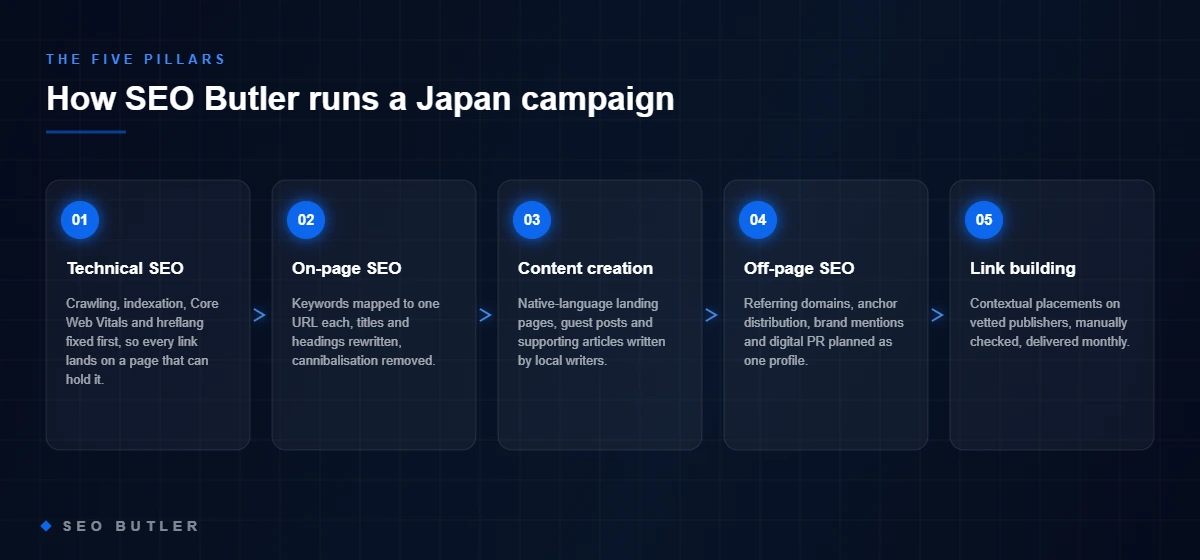
SEO Butler is a backlink marketplace and content studio in Malta, and Japan is one of the nine markets we cover. It is also our largest publisher list by some distance, at more than 350 Japanese sites. We run Japanese sites of our own as well, and the way we build their authority is the same five-part routine we use everywhere. It is worth setting out, because it is also the standard every Japanese site in the marketplace is held to.
Technical SEO
Technical SEO comes first on our own sites, because links pointed at a site that cannot hold them are wasted. Crawlability, indexing, Core Web Vitals, hreflang and the internal link structure all get checked, and hreflang and canonicals need particular care when a Japanese version sits beside other language versions of the same site.
On-page SEO
On-page SEO gives every Japanese page one job: the right keyword form on the right URL, no pages competing with each other, and titles, headings and internal anchors written in Japanese rather than adapted from English. If you are buying Japanese links, have this in order first.
Content creation
Content creation is the part of this we sell. Native Japanese writers produce landing pages, guides and supporting articles for clients’ own sites, and the articles that carry a placement. That is why none of it reads like a translation.
Off-page SEO
In Japan the rankings are decided as much by what points at a page as by what is on it. Off-page SEO on our own sites means watching referring domains, anchor text spread, brand mentions and the local citations Japanese results reward, and buying placements at a steady pace rather than in bursts.
Link building
Link building for our Japanese sites goes through the same marketplace you can buy from: editorial links on real Japanese sites with real traffic, every placement checked by a person, on established sites rather than link farms. Japanese publishers tend to have modest authority scores compared with English ones, so we list them on relevance and real readership rather than on a metric.
Search engine optimisation as one campaign
None of the five works on its own. The search engine optimisation page describes how we run them together on our own sites, so the Japanese content is technically sound, correctly targeted and supported by links from the day it goes live.
Where Japanese backlinks come from
Japanese placements are bought through the SEO Butler backlink marketplace, where every site is listed with its traffic and metrics. You look through the Japan sites, pick the ones that fit your pages, and order. Every one of them is held to real editorial standards, not picked on a number.
If you want a view on which sites suit your pages, or Japanese articles to go with the placements, ask. The six SEO services pages explain how we approach each area on our own sites.
Frequently asked questions about Japanese link building
Do you use native Japanese writers?
Yes, for everything: articles and guest posts. Machine-translated content does not go on our Japanese sites, and it reads badly to the people you want to convert.
How many Japanese links do I need?
Look at the referring domains of the current top ten for your Japanese keywords and compare them with yours. That gap, spread over a few months at a natural pace, is your volume. Send us the keywords and we will tell you what we would do for one of our own sites.
Can I buy Japanese links without the rest of the SEO?
Yes, and that is how the marketplace works. You buy the placements and look after your own site; if you want native Japanese content for your pages or for the placements, we write that too. Link building on its own is what most customers come for.
Which other markets do you cover?
Denmark, Sweden, Finland, Norway, Japan, South Korea, Thailand and Latin America, plus an international list for markets outside those. Campaigns across several markets are common, and they share one strategy and one anchor plan.
Start building Japanese links
Browse the backlink marketplace to see the Japan inventory, or get in touch with SEO Butler if you would like a view on which publishers suit your pages or need Japanese content to go with them.