

I have been in the link building industry for almost ten years, and I have been hustled a few times along the way. I know how much damage that does to a smaller company, where time and money are both short.
In this article I want to give you some insight into how links actually get built, and why it matters so much that you trust the people you do business with. That is true in most parts of life, of course, but link building trust problems are a speciality of this industry, which has a particular reputation for scammers, bad brokers and outfits that make a living hustling iGaming affiliates.
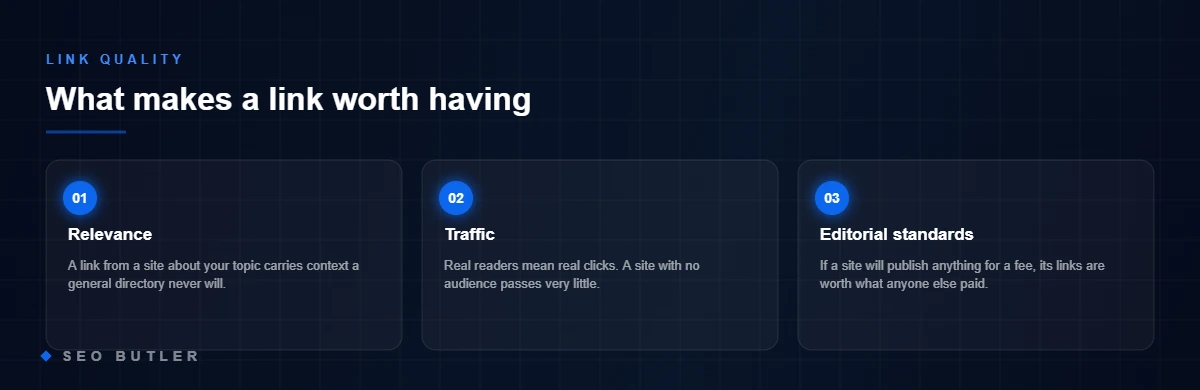
What is link building?
In plain, non-technical terms, link building is getting other websites to link to yours. There are plenty of ways to do that, but I usually split them into two groups:
- Earned links
- Paid links
Earned vs. paid: the pros and cons
With both, the end goal is the same: as many good links pointing at your website as you can get. The difference is how you go about it.
Earned links are, as the name says, links other websites give you because it makes sense for them to. A good example is me linking to Moz further down, a site full of useful guides on SEO and link building. You can find their beginner’s guide to link building here. They have produced high-quality content for years and are a trusted source, so people link to them without being asked.
Building and maintaining a site with that much content is a huge job, which is why smaller companies struggle to earn links that way. You should still try to make the best content you can for your site. Over time it can bring in free links.
Paid links are the go-to for most companies, including the big names in iGaming. To get the organic rankings you need on Google in this industry, the number of backlinks and the quality of those backlinks is the single most important factor, and that is why so many of our clients put a serious share of their marketing budget into buying links. Which brings me to the point of this article: why trust is so important when building links.
How does paid link building work?
The simplest way to think about it is as any other business transaction. You need a specific product and you need to find a supplier. Here the supplier is usually one of two people: the actual owner of the site you want a link from, or somebody who knows the owner. That second person is what I will call a broker.
If you run a website in iGaming, I am almost certain you have had plenty of emails and LinkedIn messages from brokers wanting to sell you content and links. To be clear, I know many professional brokers who take pride in delivering a good product. But for every one of them I am fairly sure there are five bad brokers and scammers trying to hustle both you and the owner of the site.
How bad brokers and scammers usually work
Here is a short run-through of how brokers normally operate, and how you can avoid getting scammed:
- The broker contacts you with one or more websites where they can place content and links pointing to your site.
- You like the offer and agree to pay X for a publication on one or more of the sites.
- The broker then contacts the owner of the site and offers to pay Z for the publication, usually keeping a 20-50% cut, sometimes more. (Which is one of the reasons to deal with the owner directly if you can.)
- The owner accepts and publishes the content.
- The broker sends you the URL so you can see your content is live.
- The broker asks you to pay the agreed amount. A broker who will only take PayPal is usually a warning sign. Ask for an invoice with bank details.
- You pay, and your side of the deal is done. (The owner of the site will of course ask the broker for payment, and in most cases the broker only pays after they have been paid by you.)
With a professional broker, that is a straightforward transaction that works out for everyone. But what if you are dealing with a bad broker, or an outright scammer?
This is where things get dicey. Here is how the scam works:
- The broker refuses to pay the invoice from the owner of the site. This usually happens 3-10 days after your content goes live.
- The owner asks for payment again and again, but by now the bad broker has stopped replying. Depending on the setup, most companies start to suspect something is wrong at this point.
- Because the owner never got paid, they remove the content you paid the broker to publish. From the owner’s side, the worst part is the time wasted dealing with the broker, taking the content down, cancelling invoices and so on.
- That leaves you in a bad spot. You paid the broker, your content is gone, and the owner of the site never saw a cent. So you have lost the money and you have lost the weeks you spent dealing with the broker. Money and time that should have been working for you by now.
We own more than 200 websites, so we have been dealing with bad brokers for years. Here are a few tips that I hope will help you steer clear of most of them.
Five telltale signs of a bad broker
- You are approached by somebody you have never heard of or dealt with, usually from a Gmail address or a thin, badly written LinkedIn profile.
- The English is poor, the grammar is off, and the replies are obviously copy-pasted.
- Once contact is made you are bombarded with a long list of sites at prices that look too good to be true, and you are pushed to close the deal as fast as possible. They can handle everything for you, naturally.
- Payment is ONLY by PayPal or similar, never by bank transfer. There is no invoice, or the one you get looks wrong.
- You have to pay before your content is online.
Any of those tells you that you are dealing with someone unprofessional, and even if the person is not a scammer I would think twice about working with people who come across that way. These five signs are not a complete guide to spotting a scammer, but they should give you an idea of what to look for.
Finally, some general advice on how to approach link building so you get the most from it and take sensible precautions along the way.
(The first tip is obviously biased, since we own all of our sites, but I do think it is an important one.)
Five easy steps to avoid being scammed
- Try to deal with the owner of the website directly. They can often give you better rates than a broker, and you have somewhere to turn if your content suddenly goes missing. A bad broker could not care less about your content once they have been paid.
- Even if the owner will not deal with you directly, you can ask them whether the broker can be trusted and get a feel for the going rate. (As I said, some brokers mark the price up by 100-300%.)
- Ask around. Most people are happy to recommend a person or a company if you ask nicely.
- Before dealing with someone, look at their LinkedIn profile, their company page and whatever else you can find online. Professional people are usually easy to spot.
- Never commit everything to one person or company on the first few deals. Do a few small ones, see how the service holds up, and increase the budget once everything checks out.
All good things must come to an end
This is not a one-size-fits-all guide to link building, but I hope it has given you a useful picture of how it works and what you can do to cut the chances of being scammed.
Take it from someone who has been there and got the “I Got Scammed” T-shirt: there are few things more demoralising than being taken for a ride.
If you have questions, comments or tips of your own, get in touch and let me know.
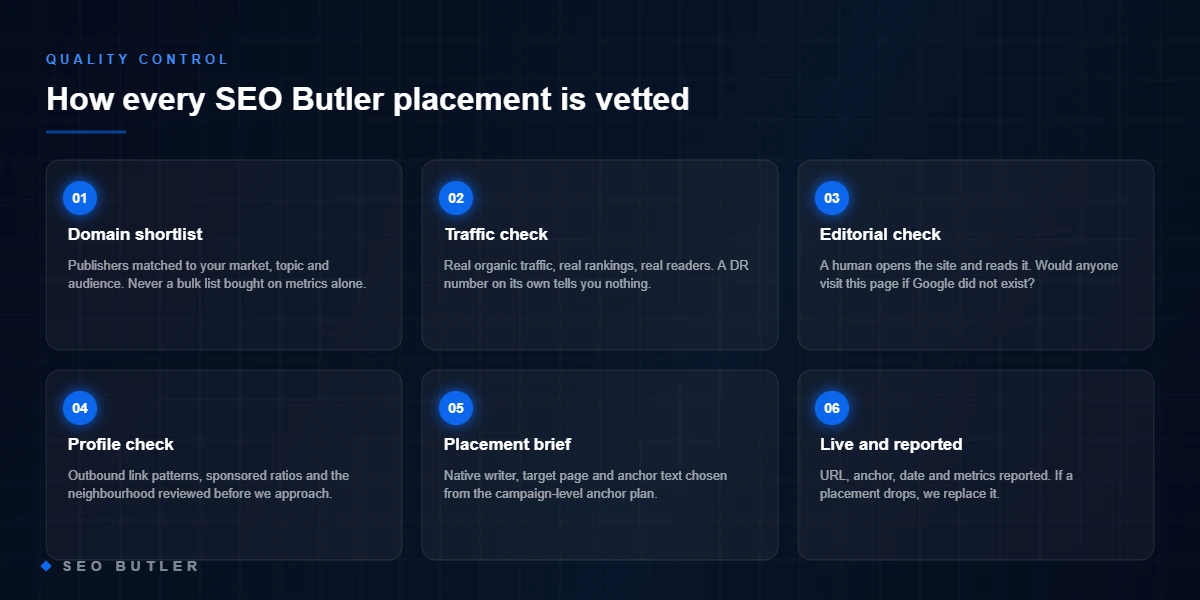
The baseline for all of this is Google’s own spam policies for web search. Most of what they describe as link spam is exactly the low-trust inventory this article tells you to avoid.
Link trust scorer: vet a prospect before you pay for it
Metrics can be faked; the trust pattern is harder to fake. Run any link prospect through the eight checks we apply before a placement goes on our own inventory, and see whether it clears the bar.
Walk away
What failed the check
How SEO Butler fits in
SEO Butler is a backlink marketplace and content studio in Malta. We run technical SEO, on-page SEO, content creation, off-page SEO and link building on a portfolio of websites of our own across nine markets, which is where the advice on this page comes from. If you need links, the backlink marketplace is where you procure placements on established sites, priced before you order, with the articles written by native speakers. The search engine optimisation page shows how the pieces fit together.
Read about the six SEO services as we practise them, see the markets we build links in, or tell us what you are trying to rank.