

Internal linking is one of the cheapest ways to improve on-page SEO. Your site already has pages with authority; linking from them to the pages that need a push passes some of that strength along. It also makes the site easier to use, because readers can get from one relevant page to the next without going back to the menu.
From Google’s side, internal links show how the pages on a site relate to each other, which helps it decide what each page is about and how it should rank.
The quickest way to find internal linking opportunities on a site is the Internal Link Opportunities tool in Ahrefs. It lists pages that could link to each other, based on the keywords each page already ranks for.
Internal links also shape how Google spends its crawl on your site. Google’s guide to managing crawl budget explains why well-linked pages get crawled first, and the video below goes into more detail.
Internal link opportunity planner: how much equity are you leaving unrouted?
Internal links are the one ranking lever you control completely and pay nothing for. Put in your content and money-page counts to see the routing target, the likely opportunity backlog, and the anchor pattern to use when you place them.
The placement rules that make them count
- 1In-paragraph beats boilerplateA link inside a relevant sentence outweighs sidebars and footers — that is the “contextual” in contextual links.
- 2Vary anchors, keep them descriptiveRotate partial-match and natural phrases; a site-wide exact-match anchor is a footprint even internally.
- 3First link on the page winsGoogle counts the first anchor to a URL — make it the good one, high in the copy.
- 4Three clicks from home, maximumMoney pages buried deeper than three clicks leak both crawl priority and equity.
How to use Internal Link Opportunities
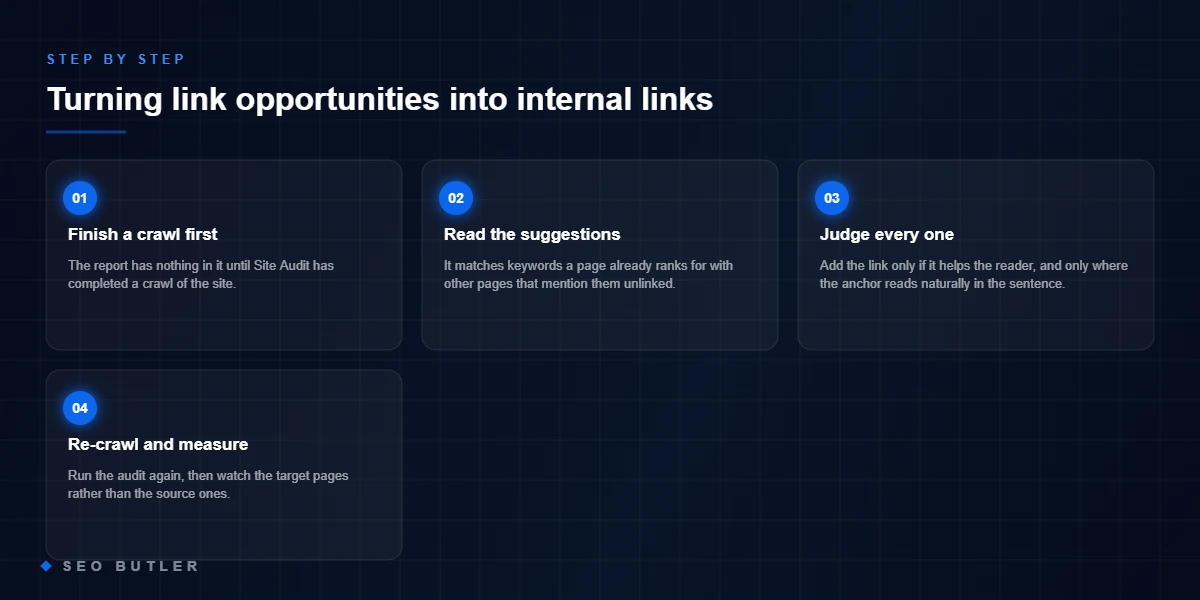
First, add the website to Ahrefs Site Audit and let the crawl finish.
Then open Tools in the left-hand panel and pick Internal Link Opportunities. It comes as a report, and every row in it is a suggestion built from the keywords the site’s pages rank for.
The columns need a little explaining:
- PR: how strong the source page’s own internal link profile is
- Source page: the page that mentions the keyword but does not yet link to the target page
- Source total traffic: the source page’s estimated traffic
- Keyword: the keyword the target page ranks for
- Keyword context: the sentence on the source page where the keyword appears
- Keyword search volume: estimated monthly searches for the keyword, worldwide
- Keyword difficulty: how hard it is to rank in the top ten for that keyword, worldwide
- Target page: the page on the site that ranks for the keyword
- Target position: where the target page currently ranks for the keyword
- Target traffic: the estimated monthly organic traffic the target page gets from that keyword
Of all that, four columns are the ones you actually work from:
Source page: where the internal link will go
Keyword: the term you want the target page to rank for, and the starting point for the anchor text
Keyword context: the sentence the link will sit in
Target page: the URL the link will point to
How to set up the internal linking
The report needs judgement. Ahrefs gives you the facts, which pages share which keywords, but it does not know whether a link would make sense to a reader. Do not just take the keyword as the anchor and the target page as the URL and paste. Read the Source page and the Keyword context first and decide whether a link belongs there at all.
- If it does, look at whether the Keyword works as anchor text as it stands or needs adjusting. Too many exact-match anchors between your own pages looks unnatural, so vary them.
- Once you are happy with the anchor, add the link on the source page, pointing at the target page.
Conclusion
Internal linking is a normal part of on-page SEO and one of the easier ways to lift the pages that matter.
The Ahrefs report does the tedious data gathering for you. The part that counts is going through the suggestions properly and only placing the links that make sense.

How SEO Butler fits in
SEO Butler is a backlink marketplace and content studio in Malta. We run technical SEO, on-page SEO, content creation, off-page SEO and link building on a portfolio of websites of our own across nine markets, which is where the advice on this page comes from. If you need links, the backlink marketplace is where you procure placements on established sites, priced before you order, with the articles written by native speakers. The search engine optimisation page shows how the pieces fit together.
Read about the six SEO services as we practise them, see the markets we build links in, or tell us what you are trying to rank.